
Economic Calendar

Washington Edges Toward Funding Deal, Beijing Lifts Export Bans — Signs of Global Stability Emerge
The US government shutdown, which has disrupted federal operations and delayed payments to employees and states, now appears close to ending after a group of centrist Senate Democrats agreed to support a stopgap deal. The proposal aims to reopen key government agencies, ensure back pay for federal workers, and extend funding for certain departments through January 30, while others would receive full-year appropriations. Although optimism is growing, the bill still faces challenges in the House, where progressive Democrats believe it concedes too much and conservative Republicans are demanding a longer-term funding package lasting through September 30. Despite these divisions, comments from Senate Majority Leader Thune and President Trump — both indicating that an agreement is “very close” — suggest that a resolution is within reach.
Meanwhile, China’s Ministry of Commerce announced the suspension of export restrictions on key “dual-use” materials such as gallium, germanium, antimony, and several rare earth and battery components until November 27, 2026. These materials are essential to industries like semiconductors, renewable energy, and defense manufacturing. The suspension of the ban and the easing of export checks on graphite signal Beijing’s willingness to ease trade tensions with the United States. This move follows an earlier agreement between Presidents Xi and Trump to reduce tariffs and pause new trade measures for a year, signaling a more cooperative phase in US–China relations.
Adding to the calm tone in markets, there are no major economic data releases scheduled for today. With the absence of significant economic reports, traders are likely to focus on political and policy developments, particularly the progress of the US funding deal and China’s recent trade policy adjustments.
The combination of these developments points toward a likely uptrend in market sentiment. The expectation that the US government shutdown could soon end reduces uncertainty, restores confidence in public institutions, and improves the outlook for consumer and business spending. Historically, markets tend to rally when fiscal and political disruptions are resolved, as investors interpret it as a sign of returning stability.
At the same time, China’s decision to temporarily lift export bans on critical industrial materials is a relief for manufacturers and technology firms that depend on these resources. This move could ease supply chain pressures, stabilize input costs, and enhance production outlooks for global industries. It also reinforces hopes that US–China trade relations are moving toward a more constructive phase, at least in the short term.
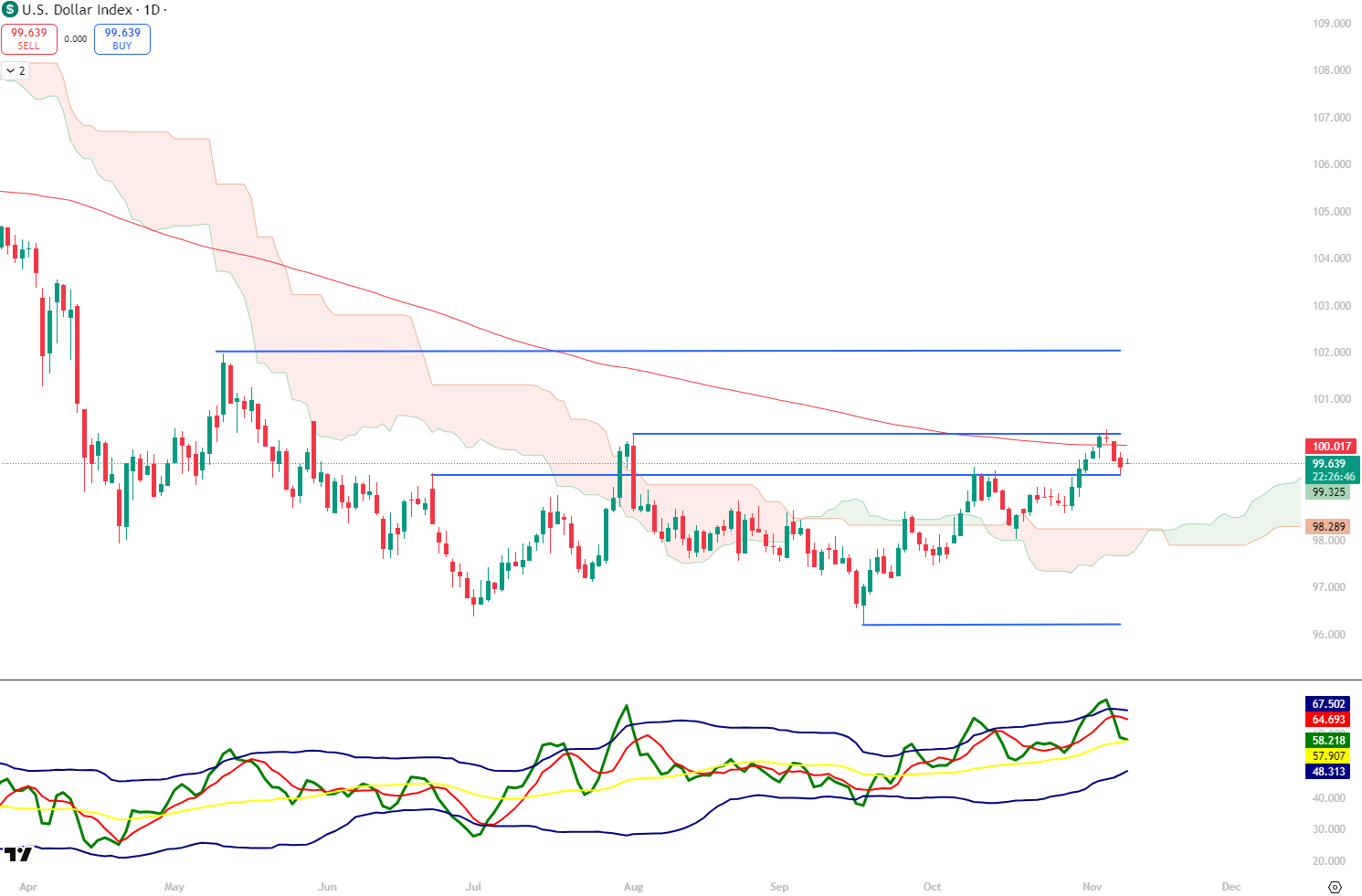
On the technical side, the US Dollar Index is currently trading around 99.64, showing a slight pullback after testing the psychological resistance near 100.00. Based on the technical indicators shown in the chart — the 200 EMA, Ichimoku Cloud and TDI - the technical bias appears neutral to slightly bullish, but with signs of near-term consolidation or mild. The broader structure favors the bulls as long as the price stays above the Ichimoku Cloud and the 99.00 support zone. However, failure to reclaim and sustain above the 200 EMA (around 100.00) could trigger a short-term pullback toward 98.30 before any renewed buying pressure emerges.
Analysis by Coach Angel, RoboAcademy
——
Disclaimer: Investing is risky. Investors should study the information before making investment decisions.
