Economic Calendar
A Fragile Recovery: Fed Warns on Inflation While Washington Reopens After Record Shutdown
Federal Reserve officials delivered a cautious and divided tone last night, emphasizing the challenges the US economy faces as inflation remains stubborn while the labor market shows early signs of softening. Fed’s Hammack warned that inflation is still too high and trending upward, with tariffs expected to push prices higher into early next year before fading in the second half. Although he described the labor market as broadly balanced, he acknowledged that softening job conditions are beginning to challenge the Fed’s employment mandate. Hammack added that monetary policy may be barely restrictive, suggesting that financial conditions are too loose to meaningfully cool inflation.
Fed’s Musalem echoed concerns about uncertainty in the data and hiring behavior, saying businesses are pulling back because of unclear economic conditions. He emphasized that despite elevated inflation risks, the broader economy remains resilient. Musalem expects some weakness in the fourth quarter followed by a rebound early next year, supported by accommodative financial conditions and deregulation. Still, he warned that the Fed must move cautiously because there is little room to ease further without risking excess accommodation. He supported earlier rate cuts to protect the labor market but said policy now sits closer to neutral.
Fed’s Kashkari maintained that inflation at 3% is still too high and highlighted mixed signals across the economy. Some sectors of the labor market appear under pressure, reinforcing the uncertainty around the overall outlook. Former Vice Chair Brainard added that cracks are forming beneath the surface, partly driven by the uneven effects of AI on productivity and employment. She said she would support a December rate cut because she sees a greater risk of a labor-driven downturn than of prolonged tariff-induced inflation. She agreed with officials who expect tariff effects to dissipate later next year, though she noted that policymakers remain in a difficult position as inflation cools but remains stuck above target.
These warnings came alongside broader national developments. President Trump signed legislation to end the 43-day government shutdown, the longest in US history. The agreement reopens federal agencies, restores workers removed during the standoff, and provides back pay for hundreds of thousands of employees who worked without compensation. While Trump accused Democrats of causing massive financial damage, the Congressional Budget Office estimated a significantly smaller economic loss of about $14B. The shutdown underscored ongoing political divisions and added another layer of uncertainty for an economy already grappling with inflation, shifting labor dynamics, and fluctuating business confidence.
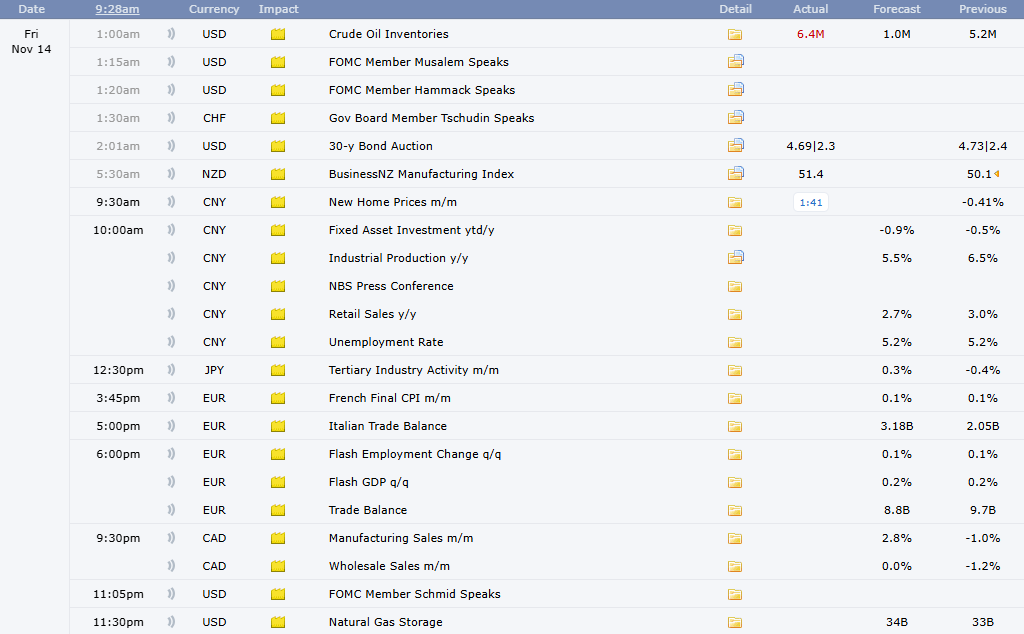
Taken together, the economic signals present a landscape where inflation remains persistent but forward-looking risks lean toward softer labor conditions and cautious business sentiment. The Federal Reserve’s messaging reflects this tension, as policymakers attempt to balance inflation control with the need to prevent a deeper slowdown. With no high-impact economic data scheduled for release today, the US dollar is likely to trade without a strong catalyst and may remain range-bound as markets digest both Fed commentary and the broader political backdrop. The tone is slightly leaning dovish due to increasing labor market concerns and expectations that tariff effects will ease later next year, potentially limiting the dollar’s momentum in the near term.
Analysis by Coach Angel
——
Disclaimer: Investing is risky. Investors should study the information before making investment decisions.
